The genome language · ISA version 13
A genome that survives being cut about.
A genome is a flat array of bytes with no parse step, no identifiers and no addresses in it. Every one of those absences is deliberate, and each of them was arrived at by getting it wrong first.
How a byte becomes an instruction
The opcode is byte % 64. Four distinct byte values therefore decode to the same instruction, which is codon degeneracy: a large fraction of point mutations are synonymous and change nothing at all.
That matters more than it sounds. Synonymous sites let neutral variation pile up quietly in a lineage until some later mutation makes it matter, which is both a smoother search landscape and a molecular clock the phylogeny layer can read.
byte % 64, so four distinct byte values decode to each of the 64 instructions. This is codon degeneracy: a large fraction of point mutations are synonymous, and the neutral variation they leave behind is both a smoother search landscape and a molecular clock the phylogeny layer can read.Addressing
Nothing holds an address.
Several instructions are followed by a template: the run of NOP0 and NOP1 instructions immediately after them, up to eight. A template has a value, read least-significant bit first, and a length.
Templates do three jobs. As a literal, appending one more letter is a small numeric change, so numbers are incrementally mutable rather than all-or-nothing. As a jump target, the instruction searches outward for the complementary pattern rather than for an address. As a promoter, it names a gene that EXPRESS binds by closest match rather than by exact name.
Because addresses are patterns rather than positions, a genome is position-independent. Duplicate a chunk, move it, or splice fifty bytes into the middle, and the jumps still land. A damaged template finds a slightly wrong target instead of crashing — which is the difference between a mutation being a variation and a mutation being rubble.
Genes work the same way. A gene block begins with GENE and a template, which is its promoter. Delete a gene and its callers are not orphaned — they bind the next best match. Duplicate a gene and mutate its promoter and you have a paralog expressed under different conditions, which is roughly how biological novelty actually arises.
Zero-length templates
NOP would silently change the stack balance of everything downstream, which is exactly the kind of cliff the rest of the design works to avoid.Totality
64 opcodes, and none of them can fail.
Every instruction is defined for every input in every machine state. There is no illegal encoding, no fault, no trap.
The stacks are circular, so popping an empty one yields zero and pushing a full one overwrites the oldest entry. Addresses wrap to their range. Division by zero yields zero. Arithmetic saturates rather than wrapping — a one-bit mutation should not flip a cell from very fast forward to very fast reverse, because that is a cliff evolution has to climb.
Any sequence of bytes is therefore a legal program, and that is the property that turns random mutation into a search instead of a demolition. If a mutated genome could crash, most mutations would be lethal for a boring reason, and the population would spend its time avoiding invalid programs instead of finding better ones.
How that is checked
Writing a cell
You do not write bytes.
There is an assembler. Labels compile to templates, and a named promoter compiles to a bit pattern through a stable hash rather than to a symbol-table entry — so the name is a convenience for you and the binding is still associative for the cell.
It refuses to assemble a source where an explicitly written template of fewer than eight letters would be silently extended by the letters after it. That is the easiest mistake to make in hand-written assembly here, and the engine’s behaviour — taking the maximal run — is correct, so the assembler catches it rather than the semantics changing.
; A cell that swims up a gradient, and photosynthesises when it stops finding one.

        GENE    #sense
        ZERO                    ; chemical 0
        IMM     %0              ; sensor slot
        OGET                    ; ( -- concentration )
        DUP
        IMM     %0011           ; threshold = 12
        CMP
        JMPZ    hungry          ; nothing here worth chasing
        EXPRESS #swim
        RET

hungry:
        EXPRESS #bask
        RET
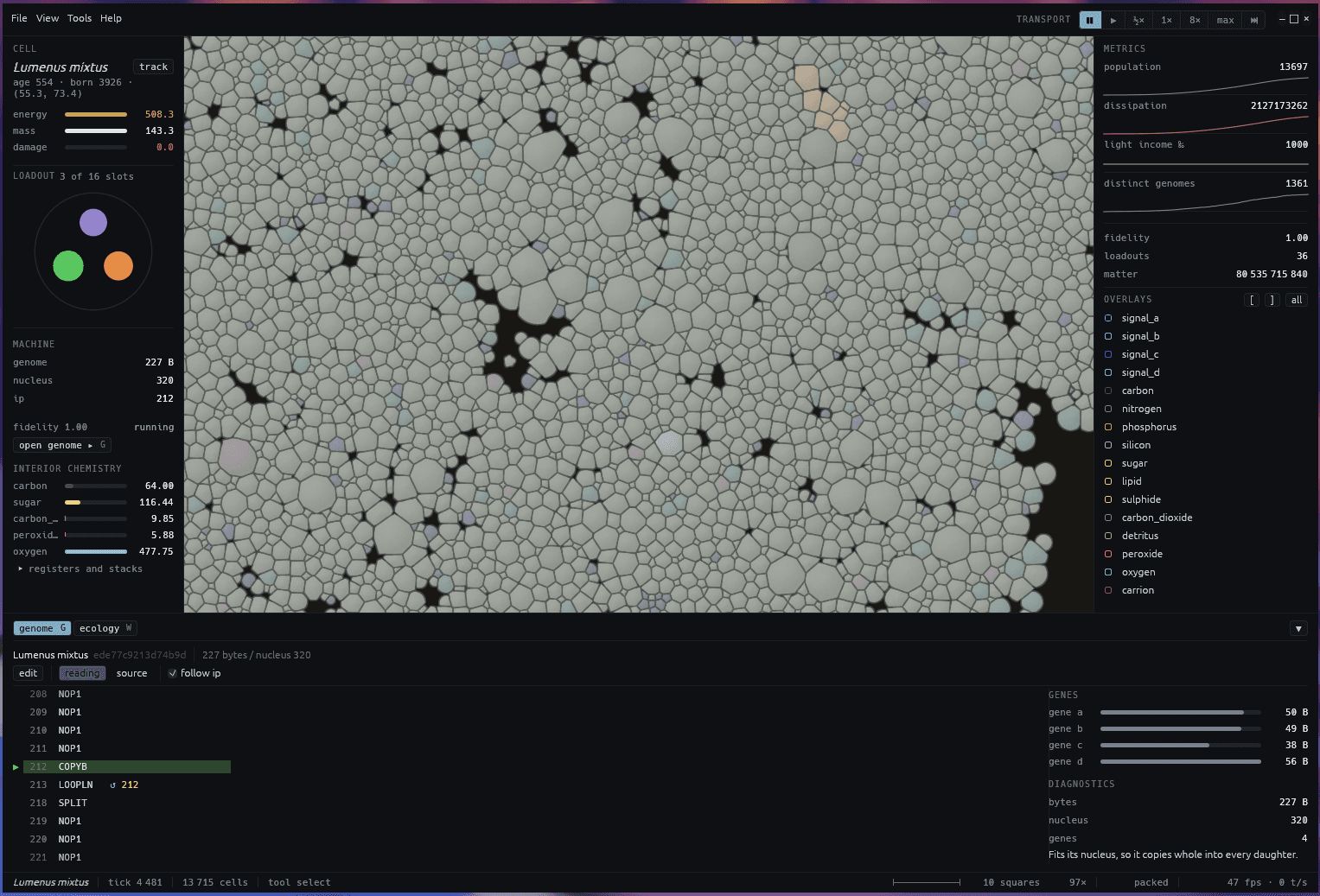
COPYB — this cell is halfway through copying itself — and LOOPLN is showing the byte it will jump back to, resolved from the template rather than written down anywhere. The diagnostics on the right add up the four genes and then say the thing that actually matters: fits its nucleus, so it copies whole into every daughter.Worked examples
Four genomes, taken apart
A plant, a hunter, a virus and a sentinel — all four shipped in the box, every instruction accounted for, and every number in them measured rather than remembered.
Read them→Reference
All 64 instructions
The complete table with stack effects, the state each cell carries, and what the instruction-set version is stamped on.
The table→