A jar of water, a lamp,
and whatever builds itself.
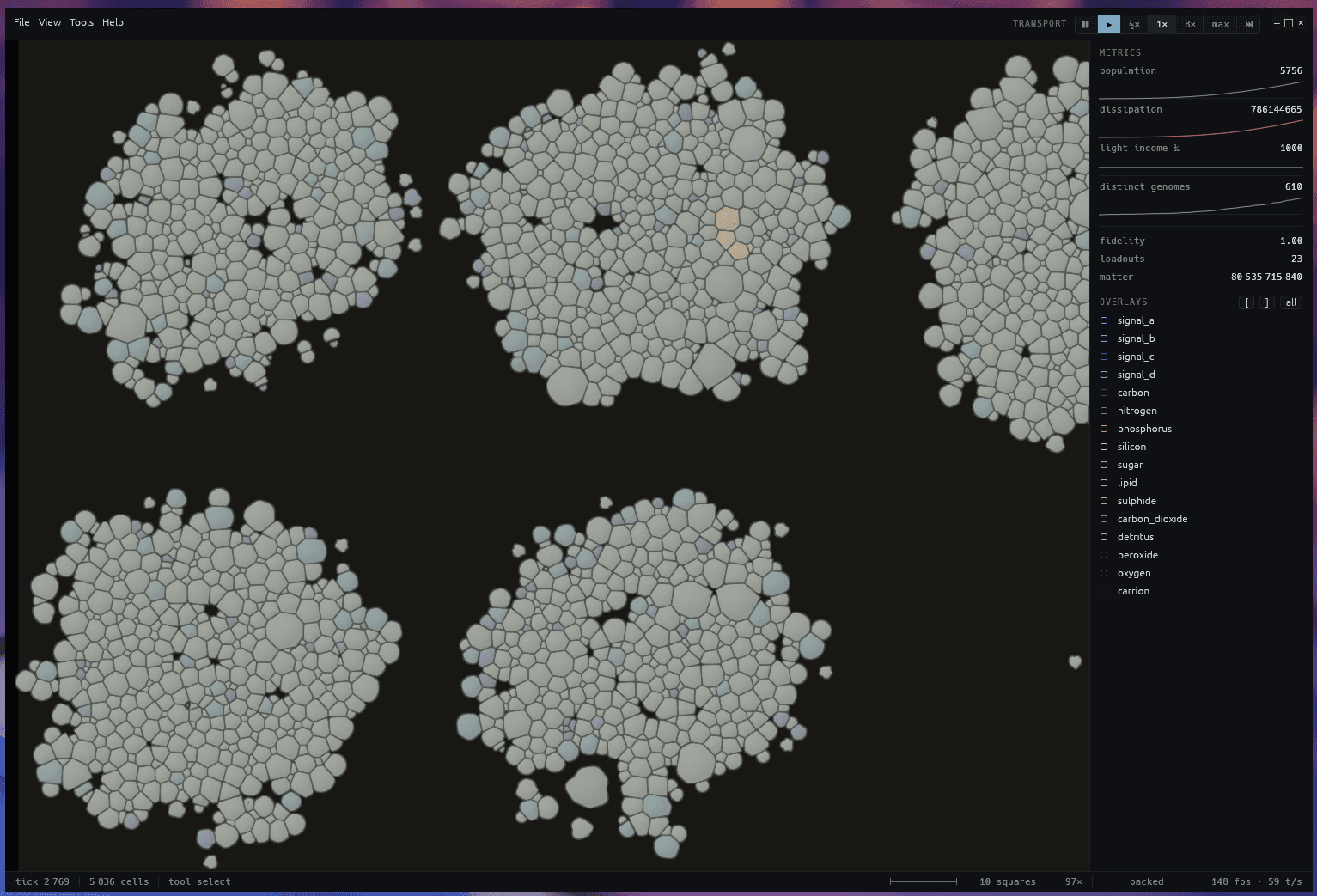
Matter inside is finite and exactly conserved — every body is built from atoms that were already there. Light is the only thing coming in, heat the only thing going out, and cells run byte-encoded genomes in a virtual machine of their own. Nothing is aiming at anything.
↑ a live simulation, not a video — about a hundred cells eating, dividing and leaving carrion.
The real thing runs tens of thousands, each with a mutable genome.
What it is
Half fishbowl, half poke it with a stick.
set it up and walk away
Choose the light — bright, seasonal, a single vent at the bottom of the world, or a slow decline to nothing over a million ticks. Drop in a cell that can copy itself. Then leave.
Come back to a population, a family tree, and a written history of everything that happened for the first time.
or get in there and interfere
Pick a cell up with tweezers and drop it on a clean slide. Draw a wall. Disassemble something alive, set a breakpoint on it, single-step it, then rewrite its genome and put it back without ever stopping the world.
Change a parameter halfway through and the change is recorded with its tick, so the run still replays exactly. Your meddling becomes part of the record.
The record
The world keeps its own notes.
Every cell records its parent and its birth tick, so the tree of descent is not inferred from survivors the way a real biologist has to — it is simply written down. Lineages that drift far enough get named, and the name sticks around after they are gone.
species page
Cilius rapidus
genus Cilius · founded tick 1 200 000 · extinct
Fast chemotroph, 3 cilia, follows chemical 7. Diverged from C. tardus at tick 1.2M. Peak population 14,000 at tick 3.4M. Extinct at 5.1M, outcompeted by its own descendant C. velox.
Alongside it: a scrubbable timeline of first occurrences — first endogenous replication, first predation, first junction, first differentiated cluster — and every mass extinction, with what caused it.
How it works
The mechanisms underneath it.
The genome
Bytes that build machinery
A flat array of bytes that builds and controls organelles rather than expressing behaviour directly.
Read on→The body
Sixteen organelle slots
Each costs matter to build and upkeep to keep. There is no cell-type field anywhere in it.
Read on→The chemistry
Nothing is created
Diffusion computed as fluxes, so what leaves one square is exactly what arrives in the next.
Read on→The record
A perfect phylogeny
Every cell stores its parent, so the tree of descent is written down rather than inferred.
Read on→Worlds
Every world asks something different.
Primordial soup
The default slide. Lit, still, well fed, no barriers — the control condition every other scenario is a variation on.
What happens when nothing is stopping you?
The shallows
A water column seen edge-on. The soup in every other respect, and the first slide where where you are is worth something.
Is it worth knowing where you are?
The vent
No daylight. One small sun at the bottom of the world, halving every eight squares. The carrying capacity is a disc rather than a slide.
Crowd the light, or learn to live without it?
The drift
Two walls make a channel and detritus flows down it. The one slide on the shelf where staying still is a way to make a living.
Is it worth staying still?
The tide
The drift's channel, with the flow turning round. Sometimes slack, sometimes brisk, and sometimes faster than anything on the slide can swim.
What wins right now?
Seasons
A short clock and a long one. Day and night over a few hundred ticks; a year over which noon itself falls to a dim winter and climbs back.
What do you do when the right answer keeps changing?
Predator introduction
A well-fed world for something to eat something else in. Nothing here makes a predator; it supplies what predation needs to be possible.
Does anything pick up a spike?
The scattering
Sixteen times the area of the soup with almost nothing living on it. The first slide where food has to be found rather than bumped into.
What is a sense worth, in a world with something to find?
I have been building this, on and off, since 2008.
Four ground-up versions, five genome languages, and one question I have not finished asking. This is the first attempt in Rust. It is not finished — v0.4.0 is a long way from the last one I mean to cut — but it runs, the source is public, and it builds in one command.